The Nigerian Bitcoin Premium: Why BTC/NGN Trades Higher Than Global Markets
Bitcoin in Nigeria consistently trades at a premium to global markets. Using 12 months of verified exchange data from 7 sources, we quantify this premium and explain why it exists.
The Data
All figures in this analysis are computed from real exchange data aggregated by moxiemetrx across Luno, Quidax, VALR, Ovex, Busha, AltCoinTrader, and Binance. We compare the volume-weighted average price (VWAP) from Nigerian exchanges against a synthetic cross-rate benchmark (BTC/USDT x USD/NGN) to measure the premium.
Key findings (April 2025 - April 2026):
| Metric | Value |
|---|---|
| Average BTC/NGN premium | 0.42% |
| Maximum premium observed | 6.27% |
| Standard deviation | 0.36% |
| Average USDT/NGN premium | 1.89% |
| Average BTC/ZAR premium (South Africa) | 0.35% |
| Average BTC/KES premium (Kenya) | 1.87% |
The Premium Is Real but Modest
Contrary to popular belief that Nigerian Bitcoin trades at enormous premiums (claims of 20-50% are common on social media), our data shows the average premium is just 0.42% over the last 12 months. This is the gap between what Nigerian exchanges charge and what you'd expect based on global BTC/USDT prices converted to naira.
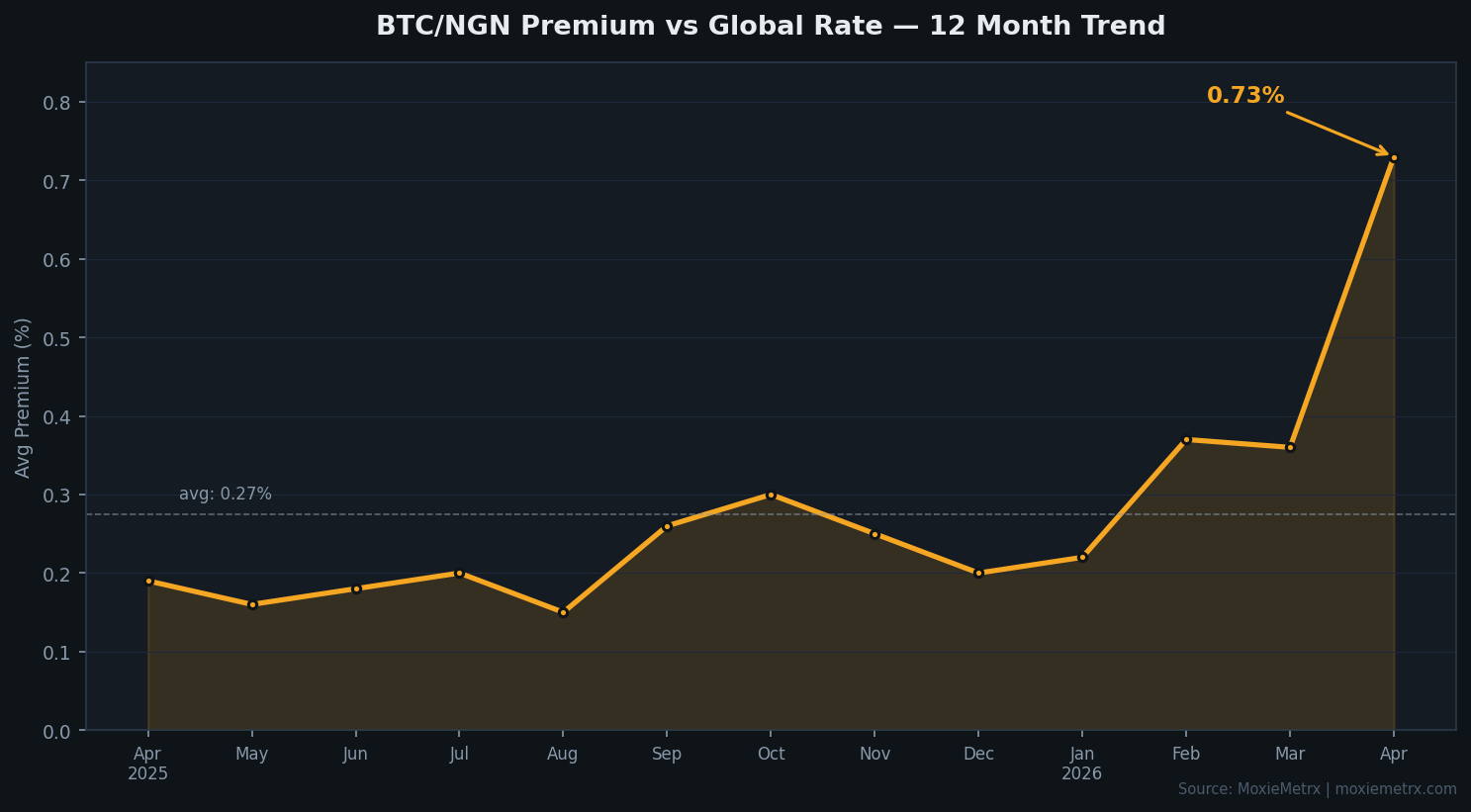
However, the premium is volatile. It spiked to 6.27% at its peak and has been trending upward:
| Month | Avg Premium |
|---|---|
| Aug 2025 | 0.15% |
| Sep 2025 | 0.26% |
| Oct 2025 | 0.30% |
| Nov 2025 | 0.25% |
| Dec 2025 | 0.20% |
| Jan 2026 | 0.22% |
| Feb 2026 | 0.37% |
| Mar 2026 | 0.36% |
| Apr 2026 | 0.73% |
The upward trend since late 2025 correlates with increased naira volatility and CBN foreign exchange policy changes.
The Stablecoin Premium Tells the Real Story
The most revealing indicator is USDT/NGN, which strips out Bitcoin volatility and shows the pure foreign exchange premium. USDT/NGN trades at an average 1.89% premium over the synthetic rate -- nearly 5x the BTC/NGN premium.
Why is USDT/NGN premium higher than BTC/NGN? Because USDT is the primary on-ramp and off-ramp for naira holders. Demand for USDT as a dollar proxy in Nigeria drives the price above the official exchange rate.
Current rates (as of April 5, 2026):
| Rate | Value |
|---|---|
| Official USD/NGN (ExchangeRate-API) | 1,378 NGN |
| Implied USD/NGN from USDT/NGN exchanges | 1,396 NGN |
| Parallel market premium | ~1.3% |
This 1.3% gap between the official and parallel rates is modest by historical standards -- during the 2023 naira crisis, the gap exceeded 40% (Reuters, June 2023). The CBN's managed float policy introduced in June 2023 has narrowed but not eliminated the parallel market (IMF Article IV, 2024).
Cross-Exchange Spread: Where the Real Opportunity Is
More interesting than the global premium is the spread between Nigerian exchanges:
| Date | Cheapest Exchange | Most Expensive | Spread |
|---|---|---|---|
| Mar 29 | 92.1M NGN | 94.5M NGN | 2.67% |
| Mar 30 | 92.7M NGN | 96.3M NGN | 3.84% |
| Mar 31 | 92.9M NGN | 97.0M NGN | 4.39% |
| Apr 01 | 94.3M NGN | 97.5M NGN | 3.45% |
| Apr 02 | 91.7M NGN | 95.7M NGN | 4.30% |
| Apr 03 | 90.8M NGN | 94.3M NGN | 3.77% |
| Apr 04 | 91.0M NGN | 94.5M NGN | 3.90% |
| Apr 05 | 90.7M NGN | 94.8M NGN | 4.50% |
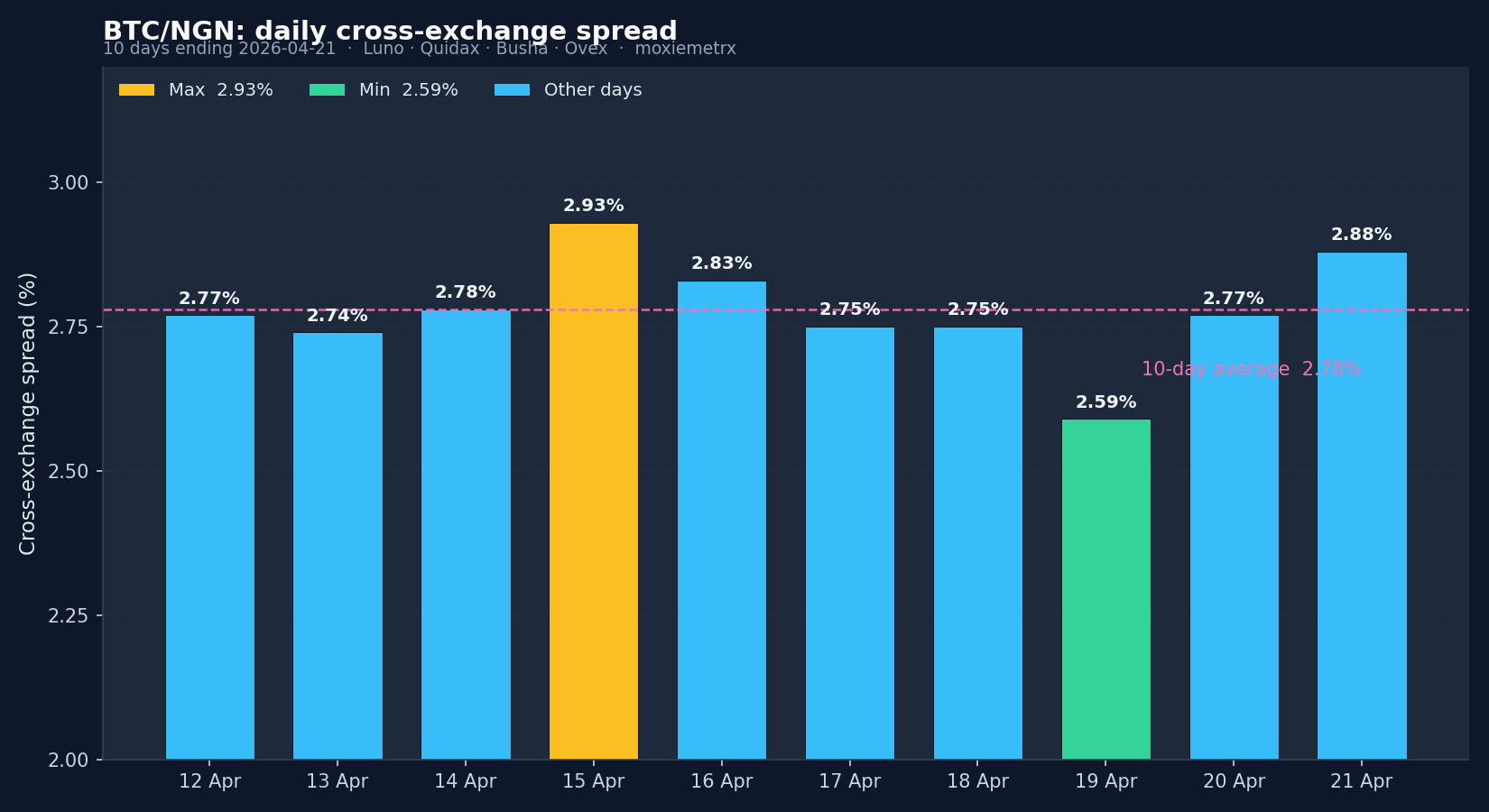
The inter-exchange spread averages 3.85% over the past week. This means the price of Bitcoin can differ by nearly 4% depending on which Nigerian exchange you check. For a portfolio worth $100,000 in BTC/NGN, using a single exchange price vs a VWAP could mean a $3,850 difference in your reported valuation.
This is why multi-source aggregation matters. A single exchange gives you a price; a VWAP gives you the market.
See it live: Cross-Exchange Arbitrage Scanner — real-time spreads across 7 African exchanges, updated every 60 seconds.
Country Comparison: Nigeria vs South Africa vs Kenya
| Pair | Avg Premium | Market Characteristics |
|---|---|---|
| BTC/NGN | 0.42% | Multiple exchanges, high demand, parallel FX market |
| BTC/KES | 1.87% | Lower liquidity, fewer exchanges, mobile money dominant |
| BTC/ZAR | 0.35% | Most liquid African market, tight spreads, multiple exchanges |
| USDT/NGN | 1.89% | Dollar proxy demand, highest premium |
| USDT/KES | 1.46% | Moderate premium |
| USDT/ZAR | 0.46% | Most efficient, tightest spreads |
South Africa's ZAR pairs show the tightest premiums (0.35%) reflecting a more mature, liquid crypto market with VALR, Luno, AltCoinTrader, and Ovex all competing. Kenya's KES pairs show the highest BTC premium (1.87%), likely due to lower exchange liquidity and the dominance of M-Pesa-based settlement which adds friction.
Why the Premium Exists
The Nigerian Bitcoin premium is driven by several factors documented in academic and policy literature:
-
Foreign exchange controls -- The CBN maintains a managed float with restrictions on dollar access, creating demand for alternative dollar-denominated assets (Ozili, 2022, "Decentralised Finance and Cryptocurrency Activity in Africa").
-
Parallel market dynamics -- Nigeria has historically had multiple exchange rates (official, NAFEX, parallel). Crypto prices reflect the parallel rate, not the official rate (World Bank Nigeria Economic Update, 2024).
-
Capital controls and remittance demand -- With limited formal channels for diaspora remittances, crypto serves as an alternative corridor. Chainalysis ranked Nigeria as the top crypto adoption country in Africa (Chainalysis Geography of Cryptocurrency Report, 2023).
-
Limited exchange competition -- Fewer market makers in NGN pairs compared to ZAR means wider spreads and less efficient price discovery.
-
On/off ramp friction -- Converting NGN to USDT or BTC involves bank transfer delays and KYC requirements that vary by exchange, adding costs that get priced into the spread.
Implications for Businesses
If you're a fintech, accounting firm, or fund operating in African crypto markets:
- Single-exchange pricing is unreliable. A 3-4% daily spread between exchanges means your reported rates could be materially wrong.
- The premium is real but manageable. At 0.42% average, the BTC/NGN premium is within normal market-making spread territory.
- USDT/NGN is the canary. Watch the stablecoin premium -- it leads BTC premium movements and signals FX market stress.
- ZAR is the benchmark. South African pairs are the most efficient African crypto market. Use ZAR pair premiums as your baseline for what "normal" looks like.
Methodology
All data sourced from the moxiemetrx API (docs.moxiemetrx.com). VWAP computed across available exchange sources with zero-volume tickers excluded from weighting. Synthetic cross-rates computed as BTC/USDT (Binance) x USD/NGN (ExchangeRate-API). Premium = |VWAP - Synthetic| / VWAP x 100. Data period: April 2025 - April 2026 (12 months, ~105,000 data points for BTC/NGN).
This analysis is produced by moxiemetrx Research. Get real-time BTC/NGN rates aggregated from 7 exchanges via our free API.
References
- Reuters. (2023, June 14). "Nigeria's naira weakens sharply as new FX regime starts." reuters.com
- IMF. (2024). "Nigeria: Article IV Consultation." imf.org
- Ozili, P.K. (2022). "Decentralised Finance and Cryptocurrency Activity in Africa." Journal of Financial Regulation and Compliance. doi.org/10.1108/JFRC-11-2021-0097
- World Bank. (2024). "Nigeria Development Update." worldbank.org
- Chainalysis. (2023). "The 2023 Geography of Cryptocurrency Report." chainalysis.com