The African Stablecoin Premium: Why USDT Costs More in Lagos Than London
If you buy 1 USDT on a Nigerian exchange, you pay about 1,396 NGN. The official USD/NGN rate says it should cost 1,378 NGN. That 1.3% gap — the stablecoin premium — is a real-time measure of FX market friction.
In Ghana, the gap is even wider.
The Data
We track stablecoin premiums across 5 African currencies using VWAP prices from multiple exchanges, compared against synthetic cross-rates (USDT/USD × USD/FIAT from institutional FX feeds).
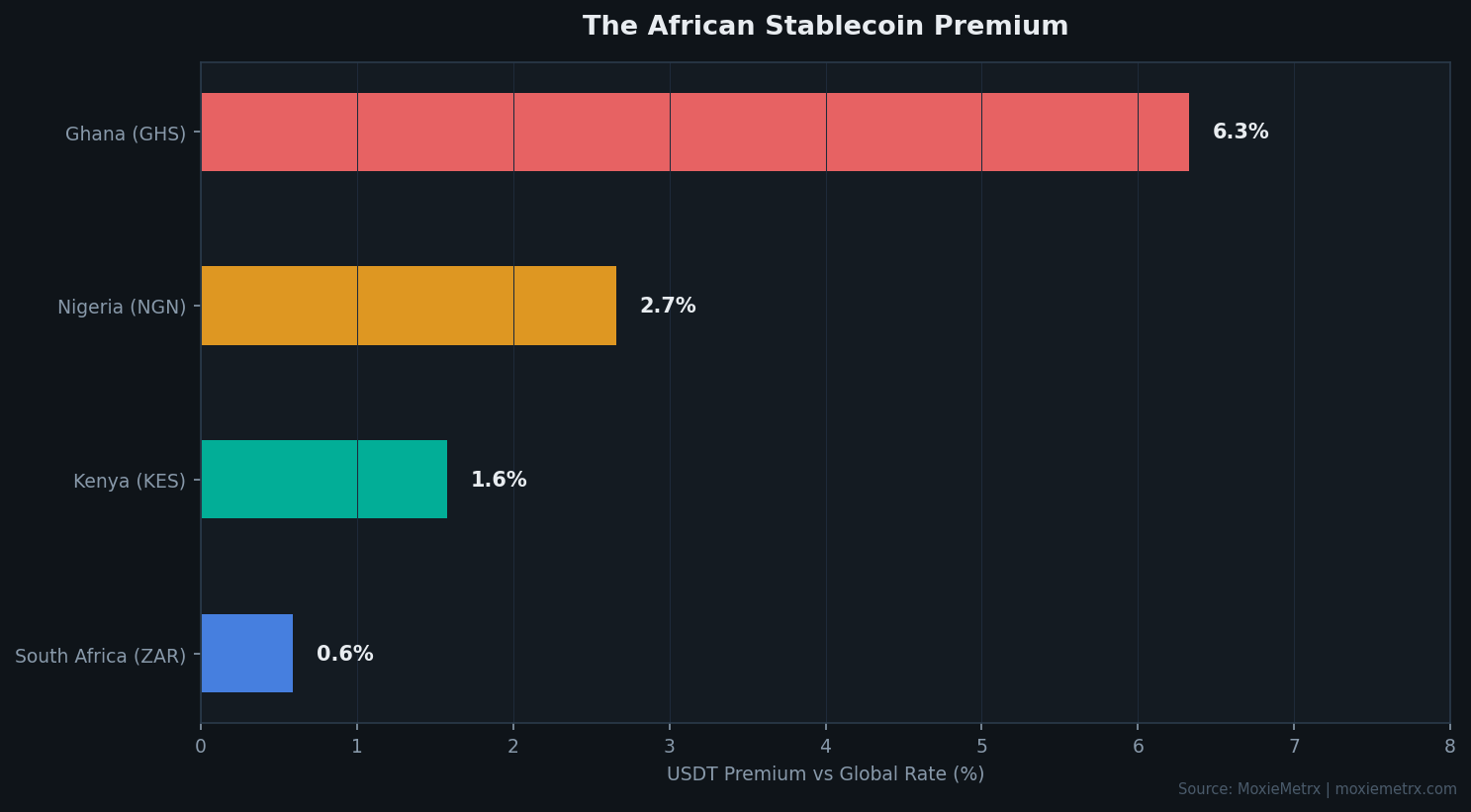
90-day averages (January - April 2026):
| Pair | Avg Premium | Max Premium | Volatility (Std Dev) |
|---|---|---|---|
| USDT/GHS (Ghana) | 6.33% | 13.50% | 2.13 |
| USDT/NGN (Nigeria) | 2.66% | 5.91% | 1.38 |
| USDT/KES (Kenya) | 1.58% | 12.12% | 1.26 |
| USDT/ZAR (South Africa) | 0.59% | 61.52%* | 0.70 |
*ZAR max premium spike is a data anomaly from a brief exchange outage, not sustained.
What Does This Mean?
The stablecoin premium is the clearest measure of dollar access friction in each country. It strips out crypto volatility entirely — USDT is pegged to USD, so any premium above the official exchange rate reflects the cost of acquiring dollars through non-traditional channels.
Ghana: 6.3% — Highest in Africa
Ghana's cedi has been among the world's worst-performing currencies. The Bank of Ghana's tight FX controls and limited dollar supply create massive demand for USDT as a dollar proxy. At 6.3%, buying $10,000 through USDT costs you $630 more than the official rate.
The Chainalysis 2023 Geography of Cryptocurrency Report ranked Ghana among the top 30 countries globally for crypto adoption, driven primarily by FX hedging rather than speculation (Chainalysis, 2023).
Nigeria: 2.7% — The Parallel Market Signal
Nigeria's 2.7% USDT premium is moderate by historical standards. During the 2023 naira crisis, the parallel market premium exceeded 40% (Reuters, June 2023). The CBN's adoption of a managed float in June 2023 and the unification of exchange rate windows narrowed the gap significantly.
The current 2.7% represents the residual cost of capital controls — access to dollars at the official rate requires documentation and approval, while USDT can be acquired instantly on exchanges (World Bank Nigeria Economic Update, 2024).
Kenya: 1.6% — Mobile Money Adds Friction
Kenya's premium is driven less by capital controls (which are relatively light) and more by settlement friction. M-Pesa dominates payments but crypto exchange integration with mobile money adds conversion steps and fees. The 1.6% premium essentially prices in the cost of moving between M-Pesa and exchange wallets.
The Central Bank of Kenya has taken a cautious approach to crypto regulation, neither banning nor formally licensing exchanges (CBK Financial Stability Report, 2024).
South Africa: 0.6% — The Benchmark
South Africa's 0.6% premium represents near-efficient dollar access. The South African Reserve Bank allows relatively free capital movement for individuals up to R10 million per year, and multiple licensed crypto exchanges (VALR, Luno, AltCoinTrader) compete on spreads.
South Africa became the first African country to formally regulate crypto through the Financial Sector Conduct Authority's CASP licensing framework in 2023 (FSCA, 2023).
USDT vs USDC: Is There a Difference?
In Nigeria and Kenya, both USDT and USDC trade at premiums, but USDC tends to be slightly lower:
| Country | USDT Premium | USDC Premium |
|---|---|---|
| Nigeria | 2.66% | 3.31% |
| Kenya | 1.58% | ~1.5% |
The higher USDC premium in Nigeria is counterintuitive — USDC is generally considered more transparent (Circle publishes monthly attestations). The likely explanation is lower USDC liquidity on Nigerian exchanges, which pushes the spread wider despite the token's fundamental quality.
Track these premiums live: Stablecoin Premium Monitor — real-time USDT premium across all 5 currencies, updated every 60 seconds.
Why This Matters
For Fintech Builders
If your app converts between naira and dollars using a single exchange's USDT price, you're embedding a 2-3% hidden cost that your users pay. Using a VWAP across multiple sources reduces this to the true market rate.
For Corporate Treasurers
Companies holding naira and needing dollar exposure can use the stablecoin premium as a real-time indicator of FX market conditions. A widening premium signals tightening dollar supply — useful for timing FX decisions.
For Regulators
The stablecoin premium is an observable, real-time metric for parallel market activity. South Africa's near-zero premium demonstrates that clear regulation and open capital accounts effectively eliminate the incentive for crypto-based FX arbitrage.
Methodology
Data: 90 days (January - April 2026), ~25,000 data points per stablecoin pair. Sources: Luno, Quidax, VALR, Ovex, Busha, AltCoinTrader. Synthetic reference rate: USDT/USD (Binance) × USD/FIAT (ExchangeRate-API hourly). Premium = |VWAP - Synthetic| / VWAP × 100.
Track stablecoin premiums in real time via the moxiemetrx API. Free tier — 5,000 requests/month.
References
- Chainalysis. (2023). "The 2023 Geography of Cryptocurrency Report." chainalysis.com
- Reuters. (2023, June 14). "Nigeria's naira weakens sharply as new FX regime starts." reuters.com
- World Bank. (2024). "Nigeria Development Update." worldbank.org
- Central Bank of Kenya. (2024). "Financial Stability Report." centralbank.go.ke
- Financial Sector Conduct Authority. (2023). "Crypto Asset Service Providers Licensing." fsca.co.za
- Ozili, P.K. (2022). "Decentralised Finance and Cryptocurrency Activity in Africa." Journal of Financial Regulation and Compliance. doi.org/10.1108/JFRC-11-2021-0097